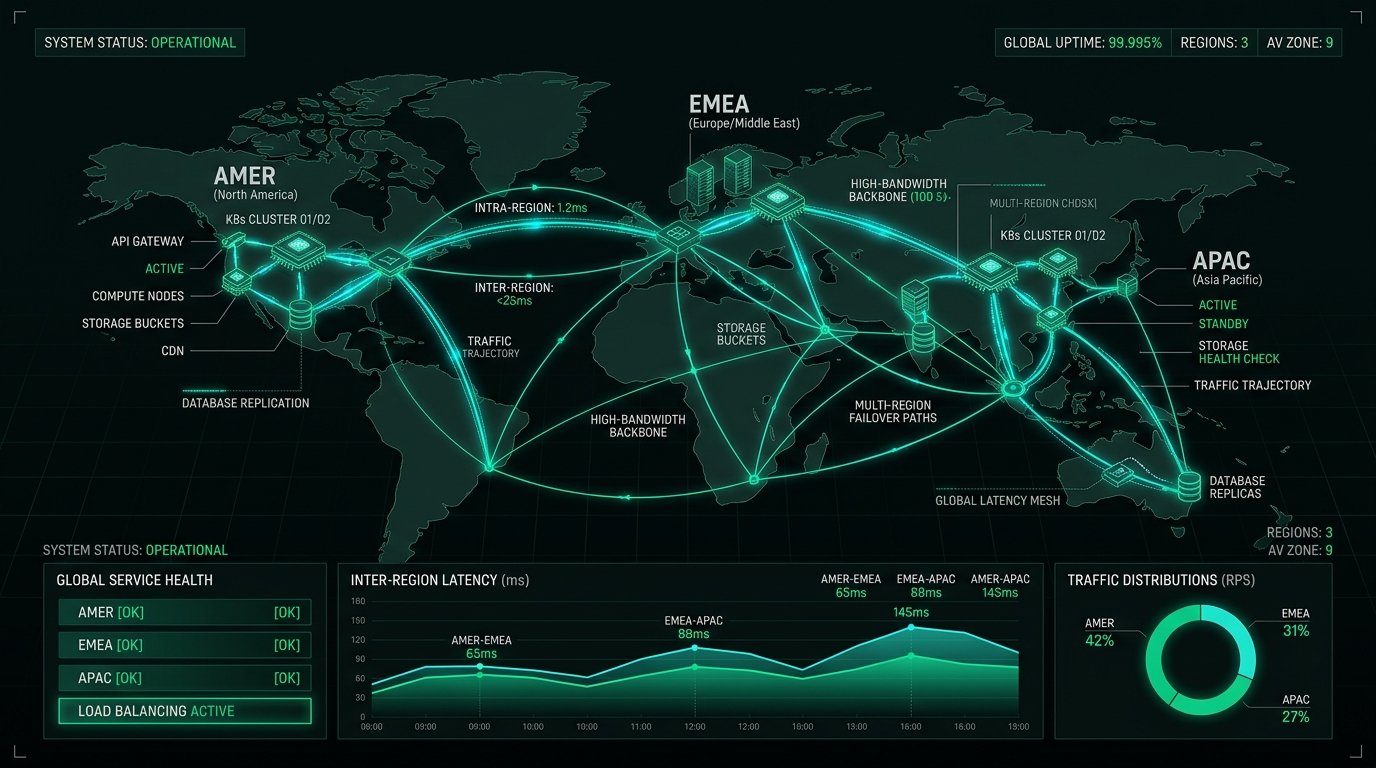
Chasing four nines of uptime by spinning up mirrored infrastructure across multiple cloud regions is a fast way to quadruple your monthly AWS or GCP bill — without actually fixing the core resilience bottlenecks that cause outages in the first place.
True platform resilience is rarely a hardware problem. It is an architectural discipline. At InfraNex, we have seen this play out across dozens of engineering engagements: teams that invest in raw redundancy before addressing their system's failure modes end up paying four times more for the same — or worse — availability profile.
Architectural resilience begins with one fundamental distinction: critical transaction paths versus asynchronous workloads. Get that wrong, and every dollar you spend on multi-region infrastructure is working against you.
The Cost of Redundancy
vs. True Availability
The intuition behind active-active multi-region setups is understandable: if one region goes down, traffic fails over seamlessly to another. In theory, this is correct. In practice, the hidden costs are substantial and often fatal to the business case.
The Three Silent Budget Killers
- Cross-region egress penalties. Cloud providers charge data transfer between regions at a premium — AWS, for instance, charges $0.02/GB for inter-region transfer. A write-heavy application syncing state between US-East, Europe, and Asia can easily generate $40,000–$120,000 per month in egress fees alone, before you account for compute.
- Subtle consistency issues. Duplicate active-active databases that accept writes in multiple regions introduce split-brain scenarios. Resolving conflicts — even with CRDTs or last-write-wins strategies — adds latency and, more critically, introduces data correctness risks that are expensive to diagnose post-incident.
- Silent replication lag. Asynchronous replication across WAN links introduces lag that is invisible during normal operations but catastrophic during failover. Teams discover their "hot standby" is actually 30–60 seconds behind at the worst possible moment.
InfraNex finding: In 70% of our architecture reviews, teams are paying for active-active redundancy across regions where the actual failure risk is concentrated in a single, fixable application layer — not in the underlying infrastructure.
Selective State Replication:
The Smarter Approach
The key insight is that not all state is equal. A payment transaction record must be durable and strongly consistent. A session token or a rendered product recommendation feed does not.
Selective state replication means decoupling stateful components from stateless microservices, then applying cross-region synchronisation only to the data that truly requires it.
How to implement this in practice
- Classify your writes. Separate writes into three categories: strongly consistent (financial records, user auth), eventually consistent (user preferences, analytics events), and ephemeral (session cache, feature flags). Only the first category warrants synchronous cross-region replication.
- Keep stateless services truly stateless. Microservices that read from a CDN-cached configuration file and emit events to a queue do not need to be deployed identically in every region. A single active region with a warm standby is sufficient, with near-instant cold-start warm-up using pre-baked container images.
- Use regional read replicas, not regional primaries. AWS Aurora Global Database and Cloud Spanner's multi-region configuration both support a single-primary, multi-region-read model. You get geo-local read latency without the consistency overhead of multi-primary writes.
Implemented correctly, selective state replication typically reduces cross-region data transfer by 60–80% compared to a naive active-active mirror, while preserving failover capability for the workloads that actually need it.
Graceful Degradation Patterns:
Staying Operational When Dependencies Drop
Multi-region infrastructure is designed to handle large-scale regional failures — AWS AZ outages, GCP zonal disruptions. But the majority of real-world incidents are not regional disasters; they are partial, dependency-level failures: a third-party payment gateway times out, an internal microservice starts returning 500s, a cache layer becomes saturated.
Graceful degradation patterns address these everyday failure modes and are far cheaper to implement than a full multi-region deployment.
Three patterns every platform architect should implement
- Circuit breakers. Implement the circuit breaker pattern (Netflix Hystrix, Resilience4j, or built-in patterns in Envoy/Istio) on every external dependency call. When a dependency fails repeatedly, the circuit opens and requests are immediately routed to a fallback — rather than timing out and cascading failures through your entire call graph.
- Localized edge caching. CDN-level caching (Cloudflare, AWS CloudFront) can serve stale-while-revalidate responses for content that changes infrequently. A well-configured edge cache means that even if your origin is completely down, 60–80% of user-facing traffic continues to be served from cached responses.
- Fallback states. Design your application to have explicit degraded modes. If the recommendation service is down, show a static list of popular products. If the real-time analytics dashboard fails, display the last-known snapshot with a "last updated" timestamp. Users tolerate degraded states — they do not tolerate blank screens or error messages.
The principle: A system that degrades gracefully under partial failure is more available to users than a system that is "perfectly redundant" but presents a 500 error when one internal dependency breaks.
The 4-Rule Audit
Before Committing to Multi-Region
Before you approve the infrastructure spend, run every proposed multi-region deployment through these four checkpoints:
- 01 Classify failure modes first, not last. Map your last five significant incidents. Were they regional cloud failures, or were they application-layer failures (bad deployments, dependency timeouts, database query regressions)? If fewer than 2 of 5 were regional, multi-region deployment addresses the wrong problem.
- 02 Calculate your actual egress cost before signing off. Run a back-of-envelope calculation on peak write throughput × data size × cross-region transfer price. If egress cost exceeds 15% of your total cloud bill at scale, active-active is almost certainly not viable — consider active-passive with automated failover instead.
- 03 Define your RTO and RPO per workload, not per system. Your payment processing service may require a Recovery Time Objective (RTO) of 30 seconds and a Recovery Point Objective (RPO) of zero. Your analytics pipeline can tolerate an RTO of 4 hours and an RPO of 15 minutes. Applying the strictest SLA globally guarantees overspend.
- 04 Test your failover path — quarterly. Failover infrastructure that has never been exercised in production is not a resilience mechanism; it is a hope. Implement chaos engineering (AWS Fault Injection Simulator, Chaos Monkey) to validate that your failover paths work as designed before a real incident validates them for you.
The Bottom Line
Four nines of uptime is an achievable goal — but achieving it by duplicating your entire infrastructure footprint across three cloud regions is, in most cases, an expensive and architecturally naïve solution. The teams that sustainably hit high availability targets do so by investing in failure mode analysis, selective state replication, and graceful degradation — before they commit budget to raw redundancy.
The result is typically a system that is both more resilient and significantly cheaper to operate than its naive multi-region counterpart.